Leaving Arequipa
So, it’s been a while. More than a week. Well. we left Arequipa, Peru after staying with Felipe’s aunt for a few days, and we were welcomed by a 5-hour climb uphill — most of it uphill — reaching over 4,200 meters of elevation. Although no shade was provided during the climb, it was pretty gradual. And to be honest, out of 5.5 hours recycled that day — 5 hours being uphill — I kind of liked it.
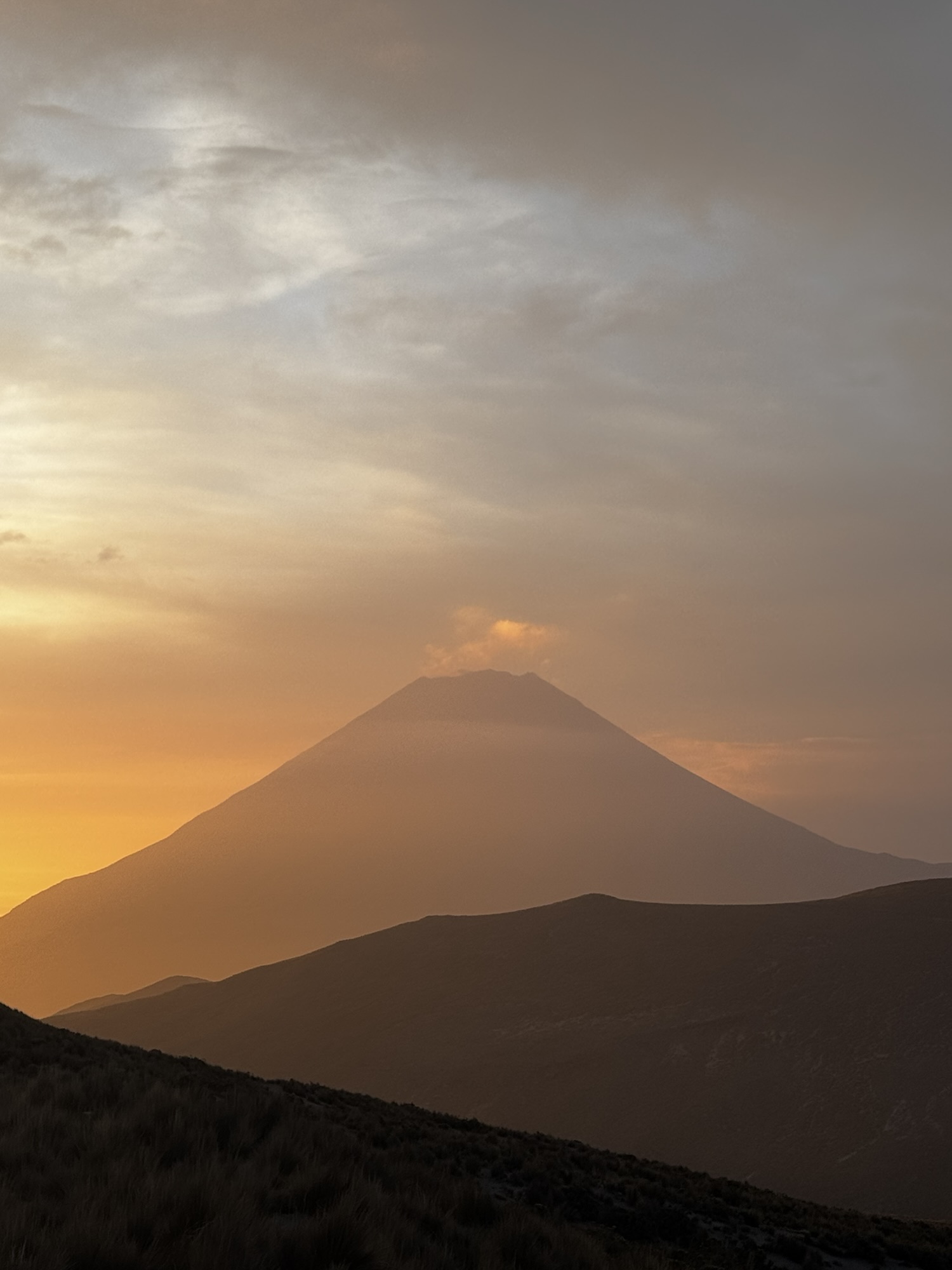
Our hard work didn’t go unnoticed, and we actually managed to find a campspot with amazing sunset views of Mount Misti.

The next day surprised us, even though it was relatively flat. It was all exposed, bumpy gravel roads at about 4,000 meters. Our goal was to cover the first 50 kilometers and reach the only shed in basically the desert, because allegedly that place had food and we could get something to eat. The 50 kilometers took us almost 4 hours.

We managed to get there and have lunch just in time before the rain started — and it lasted for the next two hours. So we just sat inside, chatting with the owners. They kept insisting that we stay, but our minds were set on moving forward.
You know, we did 50 kilometers and still had 50 more of the bumpy road. So we just kept insisting on continuing — and we did. In the end, we ended up camping at 4,600 meters, around 15,000 feet of elevation gain. But at the same time, it felt so surreal, because it was all flat. You could see some small mountains in the back, but there was no way you would have guessed this was 4,600 meters.


In these first couple of days, we were treated to some great scenery and glimpses of wild animals, including chinchillas, alpacas, vicuñas.
Following days
The next few days were interesting. First of all, we did, again, 100 kilometers, which doesn’t happen too often. But we were over 4,000 meters, so just that alone felt like we were getting into pretty good shape, especially since we did it in a reasonable time. However, just like in that area after Arequipa — reaching the Puno and Juliaca area in Peru — we noticed that the food kept getting worse and worse and worse.

So that begs the question we started discussing. Imagine you live in a small town in Peru. You have a restaurant that only does chicken, but your chicken sucks. How is that even possible? You literally dedicate your life to one thing. The locals come to your place, and the only thing you have to do is cook chicken. And I’d say every fourth or fifth time, what we get is chicken that’s raw. So we eat around it and leave the raw parts untouched. It’s kind of funny, but at the same time, we’re hungry, so we have to eat something.
Food dillema
Another point we started discussing: imagine you run a place, and two tourists — me and Phil — show up to eat. You ask how the food is, and we think it sucks, but we’re being nice. So we say it’s okay. And just like that, you walk away thinking your food is fine, and you keep cooking the same way. Meanwhile, in reality… it sucks.
So here’s the question: would you tell the honest truth if it’s a tiny town of 500 or 1,000 people, so they could actually improve, start making better food, maybe even grow their business? Or do you just stay quiet, leave it as it is, and spare their feelings, even if it means the food never gets better?
Phil thinks it’s better to stay quiet. I believe it’s better to say something, but to be honest, I haven’t had the guts to tell a local mama or grandpa that their food sucks and that they should improve. That’s what they’ve been living for their whole life, and I guess it’s part of their identity now.
Another food-related topic: in Peru, they actually eat the same meals for breakfast, lunch, and dinner. I guess that’s just a sign of poverty. You can have the same soup for breakfast, lunch, or dinner, or they’ll simply serve you rice and meat for breakfast — which maybe would be considered a proper lunch anywhere else.
Random
Another completely funny part: in Peru, near Lake Titicaca, we went through a small town called Huancané and found a house where Phil’s great-grandparents were born or lived. So, here’s a picture of that.

Crossing the border
Crossing the border into Bolivia was pretty hectic. First, we had to go to a small town on the Peru side and get a stamp showing we were leaving Peru. After that, we had to enter Bolivia the same day. But the actual border control wasn’t at the border — we ended up cycling for more than 1.5 hour to reach Bolivia. Once there, we had to find a small immigration building in the first town and get a stamp. In reality, there’s no real border control — you just pass the border, and it’s on you to make sure you get a stamp and legally enter or leave the country. So yeah, no real checkup in between.


One proud moment — I’m very proud of myself as a proper EU citizen, holding a Lithuanian passport. I entered Bolivia without any hassle. Phil, on the other hand, with his American passport, had to pay $160 for a visa. So, hell yeah, Europe! 🇱🇹
First impressions in Bolivia
As we entered Bolivia, we actually saw fewer people than on the Peru side. But within a day of cycling, we started getting amazing, stunning views of the mountains in the background. Little did we know, sooner or later, we were going to get really close to them.

Another interesting fact: the USD is pegged to the Bolivian Boliviano, also known as BOB. So even though the official rate shows 1 US dollar close to 7, the real rate on the street is closer to 1 dollar to 11 or 12 Bolivianos. That caught us off guard a bit, but I’m glad Phil did his research and we brought USD. As people say, cash is king!

As we were only one day away from La Paz, one of the capitals of Bolivia (the other being Sucre), we decided to wash our bikes — and this time, it actually went a little differently than usual.
Public transport in El Alto, another city close to La Paz, is spectacular. The city is actually built almost like a ski resort, and you use cable cars. Traveling into the city that way is amazing.
Huyana Potosí
We saw one of the tours for Huayna La Potosí, a peak over 6,000 meters. It’s considered an easy peak in technical terms, but still challenging since it’s above 6,000 meters. So after chilling in La Paz for two days, we decided to do a two-day tour.
We started at a base camp of 4,800 meters and climbed to the high camp. The first part of the climb took only an hour and a half, and we reached the high camp around 3 p.m. We chilled a little — there was no electricity, so we basically stayed until 6 p.m. We had dinner and drank a lot of coca tea to help with any potential headaches.


Then came 5 hours of rest. To be honest, I wouldn’t call it real rest. Mixed with anxiety, excitement, all the emotions, and the elevation, I barely slept for an hour. During those 5 hours, I had to wake up twice to pee. I felt like nobody was really sleeping. But we were ready to tackle the peak the next morning. I guess that’s the price of something really cool — you just have to dig deep and find the energy to do it.
So basically, we were moving in pairs — two people with one guide. Our guide, Max, was amazing. He kept a slow and steady pace, with stops every half hour for a few minutes. He told us when to drink water, when to eat chocolate, all for optimal performance — and it actually worked. Even though we left as the last ones out of 12 people in our group, we ended up passing everyone, and we even overtook other tour groups as well — maybe an additional 15, 20, 30 people. I’m not fully sure.
I wasn’t in the best mental state climbing up. Physically, I could handle it — that wasn’t the issue. It was hard, but we were taking it slowly, basically doing zone 2 training. My heart rate stayed around 120, with the average being about 123.
But knowing that elevation can mess you up at any moment, and that someone had died on this mountain just three days ago, made it hard to fully focus on the moment and appreciate it. My mind was always thinking about getting up as fast as possible, then back down from the high camp to base camp, and only then could I relax. It was tough to stay present, but I guess that’s natural when doing a peak like this for the first time.


Conclusion? I’m not fully sure. Have I enjoyed the climbing? Yes, absolutely. Would I do it again at 6,000 meters? I think the risk at that elevation is just too high. I’d probably give mountaineering another go on more difficult routes, but at lower elevations in the future.
Weekly stats
Weekly Stats (7 days of cycling)
545 km | 33 h | 5,555 m gain
Daily Averages
78 km | 4 h 43 m | 794 m gain
Extra
1. So here’s my hot take. In South America — the countries we’ve been so far, Colombia, Ecuador, Peru, and Bolivia — every white person seems to get called “gringo,” or “choco” here in Bolivia. So the question is: is it just a commonly accepted way to refer to white people, or are they deep down a little bit racist? Who knows. I feel like there’s no one specific answer.
At the same time, getting called “gringo” seven times in a row by the same old lady? Yeah, it pisses me off. But I also get it — she comes from a different socio-economic background, so maybe for her this is completely normal. Just some food for thought.
2. Additionally, when I got my harness for climbing Huayna Potosí, I didn’t check it first — and then I realized it was too small. So basically, I had to exchange it just five hours before summiting. But in the end, someone gave me a really nice compliment: my legs are big, so I’m clearly not skipping leg day. Maybe biking for almost two months has its perks, which I’m happy about. Not to mention the endurance — we were the first ones to climb up the mountain.
3. Y lo último que quería decir es que todas las señoras mayores que conocimos en este viaje —trabajando en tiendas, restaurantes o alojamientos— nos decían que Dios las bendiga. Hay mucha gente que cree en Dios, y creo que tuvimos mucha suerte de ser bendecidos tantas veces por diferentes personas.