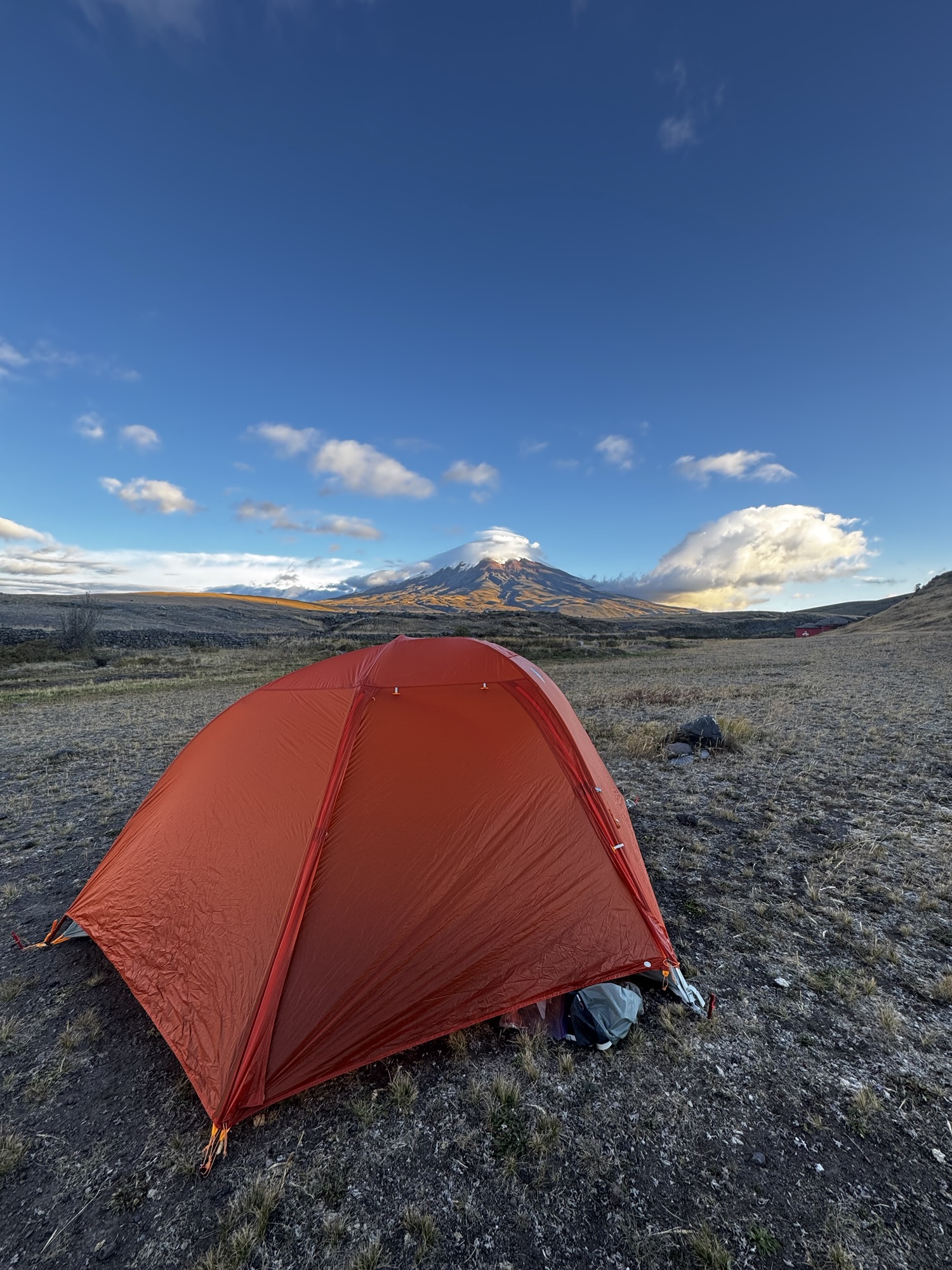
Day 17
Today was by far the hardest day. We loved staying with Santiago and Ana Lucía at Casa de Ciclistas in Quito, but we left at 10 a.m. knowing we had to enter the Cotopaxi National Park by 3 p.m. — just 50 km away (including 1800 m vertical gain). I thought, okay, 50 km in 5 hours, that’s doable. Nope.
The first 25 km? We crushed them in an hour and a half. The next 25 km? Took us over three hours. Fourteen kilometers of cobblestone climbing, 700–800 meters up. At times the gradients hit 12–15%, once even 18%. I think I spent a solid 20–25 minutes just pushing my bike uphill. Honestly, I wasn’t sure if I was in Ecuador or riding a stage of Paris–Roubaix.

We also skipped food early on, thinking we’d grab a snack later — but nothing was open. So I bonked hard. I couldn’t even ride a 2% incline; I was stepping off the bike and pushing. Add the headwind at 3,700 m, life is just rough.
Still, when we rolled up at 3:40 pm, we thought we’d be stuck camping at the entrance — but no. This is Ecuador, baby. The rangers just waved us in. Three more kilometers later, we’re pitching the tent outside a lodge with Wi-Fi. Food costs 5x town prices, but who cares. We’re in Cotopaxi. Cotopaxi, babyyyy!

Day 18
Surprisingly, I didn’t sleep too badly at 3,700 m, though my sleep score said 47 — even after 8.5 hours. Whatever.
Since we came in through the northern entrance — and the road was absolute shit — we knew most people enter from the south. So our plan was to ride across the park, get to the southern side, and see if we could hitch a ride up to 4,500 m (last parking lot). No way we were cycling that road. From there, we’d climb the extra 300 m to the Refugio and hope for a view of Cotopaxi.
It was raining, visibility sucked, but I figured: if I’m already here, I might as well give it a go and do my best trying to get as close as possible to Cotopaxi.
Hitching took about 15 minutes, then we ended up in the back of a truck. Tour group. Suddenly they wanted us to pay, even though nobody mentioned it before. 5$ each.

At the Refugio we didn’t see much, but standing at almost 5,000 m with the air thin and my legs heavy still felt good. Felt bad for people who were summitting that day.

Afterwards, we had a chill 2.5-hour ride to Latacunga. Dinner was ramen, burger, tacos — all in one go, one after another. I ate everything and was still hungry.

Following days
Like always, the morning started with pan — the most mediocre bread imaginable. This time I gambled on one with onion and cheese, and honestly, not bad. A rare win.
The ride began easy, just one 400 m climb, but I couldn’t shake the feeling something was off. Was it me? The bike? Or maybe those 45 mm tires actually do make every gradient feel 2% steeper. Either way, I felt weaker than I should have.
Then came a lot of downhill. Lunch was encebollada — hands down one of the better local meals.

The scenery at first was meh, but once we left the main road, riding through the valley was fun again. We skipped some hot springs (road down looked like hell) and later learned that when Ecuador says “road closed,” they really mean it.


The next day was the complete opposite. We started early, facing 1,500–1,600 m of climbing, and during our first break (six kilometers in, over breakfast) we decided to detour into Riobamba. The reason? Ice latte. Simple men, simple pleasures.

On the bike I felt stronger than ever — like my “bike legs” finally clicked. Climbs weren’t a grind anymore, they were actually fun. I even started building a Spanish playlist to keep the mood high (suggestions are welcome).
Further route
The way we think about our trip is basically in two days, two weeks, and two months: 85% of our focus on the next two days, 10% on the next two weeks, and maybe 5% on the next two months. Keeps us flexible, but also thinking ahead enough to hit the highlights.
After talking with a couple of riders going south-to-north — and digging online — it’s clear: the Peru Great Divide is the holy grail of South American cycling. Patagonia gets mentioned a lot, but the hype is really around Peru. Lagunas in Bolivia and Patagonia itself also promise the kind of remote, wilderness experience we’re really craving.
Problem is, if we stick to our current route, we’ll reach the Great Divide around mid-October, right when the rain season starts. Been there, done that. Not pretty.
We’ve only been riding near the Pan-American Highway for a day and a half, but it’s already clear that’s not the experience we’re looking for. Having the flexibility to skip sections, knowing we don’t have a full year to ride, and focusing on the most epic parts — that feels right.
So, plan change: skip the 1,300 km of southern Ecuador and northern Peru, hop straight to the Great Divide. That includes 3 buses —14 hours, 7 hours, and 6 hours—because nothing is a straight shot in South America. Lots of sitting, but we’re trading ‘meh’ roads and bad weather for more of the good stuff. Short term pain for long term gain.
Right now it feels pretty urban — showers every other day, small comforts — but what we really want is wilderness. Rough plan: Peru until mid-October, Bolivia until mid-November, then four to six weeks making our way from northern Argentina to Patagonia. January in Patagonia, and maybe a bit of February if we still feel like riding.
Simple goal: skip the filler, chase the epic, and get into the remote stuff we’ve been longing for. Who knows though, the plan might still change 10 times.
First three weeks were a great boot camp testing out the gear.
Cuenca, Ecuador
Cuenca, Ecuador deserves a separate mention. Hands down, it’s the best city we’ve visited so far in both Colombia and Ecuador. It’s vibrant yet calm, small enough to feel cozy but big enough to never get boring. The European-inspired vibe definitely spoke to me—quiet streets, no constant honking, and locals themselves come here on holiday. The food scene is great, and at 2,500 meters it’s perfect temperature wise. Honestly, I could see myself spending a couple of months here working remotely and just hanging around. Maybe that’s a future plan.
By the way, I tracked everything I ate during just one day in Cuenca while waiting for the bus:
- breakfast: chocolate croissant + croissant + flat white
- pre lunch: encebollada
- lunch: burrito + coke
- post lunch: iced latte + carrot cake
- dessert: macchiato + pistachio cheesecake
- dinner: 2 burritos (1 for the bus) + 0.5 quesadilla
- post dinner: passion fruit milkshake
All of this was 28€ / 33$
Otras cosas
1. He leído mi segundo libro, El Principito. La verdad es que lo leí hace unos 15 años en la escuela, en lituano, y ahora lo estoy leyendo en español. No fue muy difícil, pero me parece un buen libro para recordarme que podemos disfrutar más de las cosas y no ser tan serios en la vida. Estoy abierto a sugerencias de otros libros que me puedan recomendar.
2. El otro punto es la comida rápida en Ecuador. En los pueblitos pequeños casi no hay variedad: siempre pollo broaster, papas fritas o hamburguesas. Algunos días hasta terminamos comiendo eso dos veces. Y lo curioso es que las papas fritas siempre vienen sin sal, porque dicen que es “más sano”. Pero claro, con tanta fritanga alrededor, ya no sé si eso cambia mucho.

3. También, un señor francés de unos 70 años o más nos dijo que toda la comida sabe rica cuando estás a más de 3.000 metros de altitud. Estoy de acuerdo: es verdad.
4. En Ecuador me sorprendió que, en los restaurantes, cuando alguien entra y te ve comiendo, aunque no te conozca, siempre te dice “buen provecho”.
5. La mayor enseñanza de la semana pasada: puedes planear todo lo que quieras, pero al final los planes cambian. Nosotros, por ejemplo, decidimos tomar 3 autobuses para llegar a Perú. Al final, lo importante es ser flexible y dejarse llevar.
Stats
Third Week Cycling in South America (5 days)
345 km | 20h 29m | 6,309 m gain | 9,767 kcal
Daily Averages (5 days)
69.0 km | 4h 06m | 1,262 m gain| 1,953 kcal
