Lessons learned
When I was prepping to write the blog for week one, I was slightly hesitant and felt weird. And Phil, as always full of wisdom, told me: ‘a farmer must farm.’ That’s how I felt. And honestly, writing the blog for week two feels so much easier.
I guess the best way to describe week two is with a phrase: there’s no need to judge the decisions of the past with the information of the present.
I suppose the only way to learn in biketouring (bikepacking) is by breaking cranks, blowing tires, and tweaking setups along the way. Feels like I’m just paying tuition to be part of this journey. Last week we talked about how I didn’t install my pedals properly and ended up fucking up the crank. This week? I’ve got a story about my tires. Throughout the week something felt off. My rear tire kept losing air more than usual, and I had to keep pumping it up. It didn’t make sense — Phil’s tires were always fine, and mine were constant trouble. Once I got a hole, the sealant plugged it up, but it never really closed properly. Every time I inflated it again, sealant would burst out and the tire would deflate right after. Phil offered to use Dynaplugs for the trouble spots, so we put in two of them. For those who don’t know, Dynaplugs are these little metal-and-rubber plugs you jam straight into the hole — kind of like sticking a cork in a wine bottle, but for bike tires.

Usually a Dynaplug does the trick — you just jam it in, cut the end, and you’re good. But this time, even with Dynaplugs, my tires kept leaking. So I went full ChatGPT deep-dive mode and figured out the problem: my tires weren’t even tubeless-ready. Everything else on the setup was tubeless, except the tires. Meaning… I’d ridden over a thousand kilometers on a tubeless setup that wasn’t actually tubeless. Pure ghetto style. It worked fine on smooth terrain, but once the roads got rougher, the whole system just couldn’t hold up. Basically, it worked as long as I didn’t pump the tires past ~40 PSI. Any higher and the air would just start hissing out through the Dynaplug spot. Still, it held for a couple of days — I probably rode around 150 kilometers like that — until the last day, when it finally gave up. By ‘gave up,’ I mean the tubeless sealant started pouring out the sides while I still had 14 km to town. So I went full survival mode: pump it up to the max, ride hard for five minutes while it leaked, stop, pump again. I repeated that seven or eight times until I was maybe 3–4 km from town… and then the tires completely quit on me — flat in under 30 seconds.

Just to make things better, all this was happening at 3,500 meters, in the rain, with clouds and fog, on nothing but rocks and cobblestone. The only blessing? At least it was downhill.
So what does that entail? Honestly, I don’t know — except that I clearly wasn’t fully ready for this trip. I was 100% sure my tires were tubeless ready, but turns out it was just a similar model that was. My bad. And in Quito, finding a 42mm gravel tire is basically impossible, so I had to swap both for 45mm. In the end, that little mistake set me back $150. So that’s where the quote of the week comes from: the decisions of the past can’t be judged with the information of the present. At the time, I thought I knew everything — turns out I didn’t. You can only see it as a sunk cost and move forward. Just a little setback. It hit me emotionally, because I really thought I was better prepared. But honestly, I just hope this is the last bike fix I’ll have to deal with for a while.
Riding
This week’s story can be split into three parts. First, the Trampolín de la Muerte — the ride from Mocoa to Pasto in Colombia. Second, leaving Tulcán, because yes, we actually crossed into Ecuador. And third, all the rides in between.
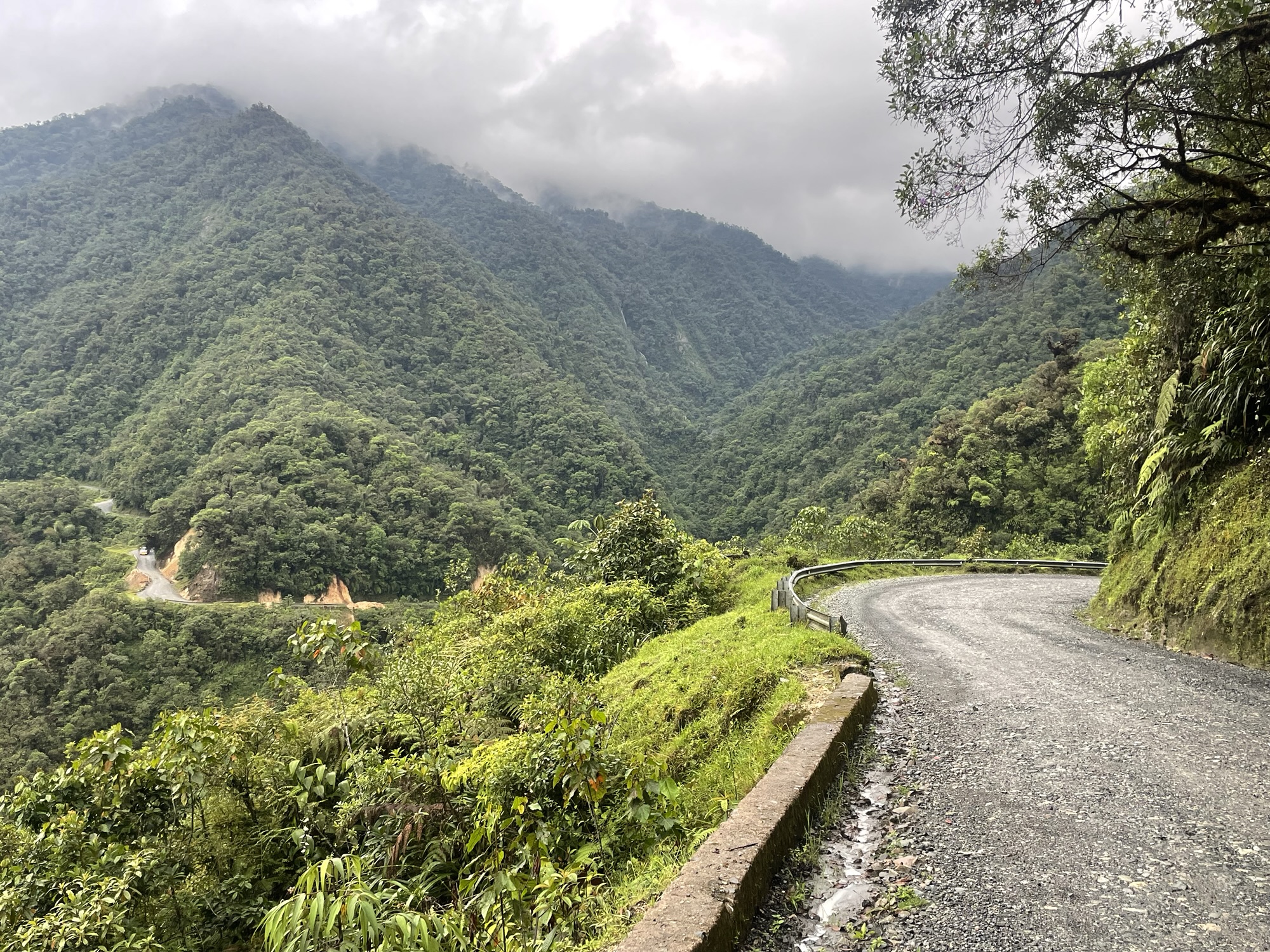
Well, let’s begin with Trampolín de la Muerte, also known as the Death Road. It’s in the Putumayo region, but we renamed it Puta Madre. Why? Because it rains all the damn time. I’ve never seen so much rain in my life. Add to that the most exhausting ride — hours of climbing uphill on rocks (not even gravel) — while small cars squeeze past, and at the same time bigger trucks grind through, delivering to tiny towns or just using it as the main connection between Pasto and Mocoa. All of this in the pouring rain. Brutal, but definitely the definition of type 2 fun.


We knew it was gonna rain, we just didn’t know how bad. The strategy was simple: only think about the next roof over our heads. First checkpoint — a church near the start. When we got there it was just light showers, nothing crazy, so we pushed on. Next stop, a “restaurant.” And yeah, technically it serves food, so it’s a restaurant, but let’s be honest — would you really call it that? Doubt it. Anyway, we just broke the day into small chunks and kept going. It rained non-stop, but it didn’t turn into full-on downpour until early afternoon. We ended up stuck in one of the abandoned houses by the road and decided to call it home. The plan was simple: if the rain stops for more than 5–10 minutes, we keep going. But it was 2:30 p.m. and it just didn’t stop. It rained, and rained, and kept on raining — for 18 straight hours. By 5 p.m. we called it. Sunset was around 6, and with the fog we could only see 10–20 meters ahead. On a “death road” in those conditions? No thanks. So yeah, that abandoned house turned into our camp for the night.


Just to put things into perspective: we cycled 36 kilometers in 4 hours. That’s an average speed of about 9 km/h, while climbing 2,000 meters on rocks and gravel. The average incline? Somewhere around 6–8%. And honestly, when it dropped to 3–5%, it felt like a rest. Funny how quickly your definition of “easy” changes.
Next morning, we had checked the weather forecast and knew we had a couple of dry hours ahead. So we pushed on. In about an hour and a half we managed 13 kilometers, then stopped at a “restaurant” just before the next downpour started. And that was at 9 a.m.
At that point we decided it was probably best to hitch a ride — it was clear it was going to rain all day, every day, for the next five days or so. That’s why, at least in our heads, the region stopped being Putumayo and became Puta Madre.

We got picked up by a local driver named William, who runs that route a few times a week. We spent over three hours in his car just to cover 80–90 kilometers and finally get out of that cursed stretch.
What followed was a day and a half of relatively uneventful riding through the border towns, trying to cross into Ecuador. Honestly, it wasn’t that bad. We rode through one of those massive canyons, but since we had to stick to the main road, we tried sneaking off onto smaller ones whenever possible. Of course, that just meant more climbing—basically, we were going uphill the entire day. We didn’t cover many kilometers. Meanwhile, my tire kept leaking, so I was slowly inflating it over and over, already coming to terms with the fact that I’d have to swap them out soon.

Crossing the border into Ecuador was kinda interesting. First of all, we saw a lot of migrants. No idea where they were coming from—maybe Venezuelans or others heading north. But in the last 30–40 kilometers before the border on the Colombian side, there were a lot of them.
When we actually tried entering Ecuador, nobody checked us. We literally just rolled through the border. There were maybe 20 agents working as migration officers, but nobody stopped us or asked us to do anything. So we just cycled straight into Ecuador. Fifteen minutes later we were already climbing a hill, thinking all was good—until we realized, okay, we probably fucked up. At the top of the hill it wasn’t police, but the military, stopping vehicles for extra security checks. We asked them where to get the stamps, and they told us we had to turn back. So yeah, the worst part was that we had to descend back. And descending was fun — flying down at 50 km/h — but the thought that we’d have to climb it again right after wasn’t. First, we had to go back to the Colombian side and officially get the stamp that we’d left the country. Then we crossed over again to the Ecuadorian side. They didn’t ask us anything, no questions at all, but the whole process still took about an hour and a half. By the end, we finally had everything sorted and were actually ready to hit Ecuador.
Starting in Ecuador, we decided to take a less-traveled route, something that looked like gravel on the map. Oh boy, were we wrong. We rolled out of Tulcán at about 3,000 meters and climbed up to 3,700. At first it was fine, the climbing was steady, but then the “road” turned into rocks, overgrown brush, almost singletrack, and mud. Before long, we were pushing our bikes more than riding them.
In four hours we managed just 40 kilometers. It was wet, foggy, and visibility was close to nothing — you really couldn’t see much. Sure, it was beautiful in its own strange way, but that’s also when my tire gave up completely and started leaking every few minutes. So when the downhill finally came, let’s just say it was… interesting.

General thoughts
1. Santiago, el hospitalero de la Casa de Ciclistas en Tumbaco, cerca de Quito, nos dijo una frase que se nos quedó grabada: los peores caminos llevan a los mejores destinos. Y creo que es verdad si vemos las aventuras que tuvimos la semana pasada.
2. Además, Santiago, el hospitalero, abrió su casa a los ciclistas hace 34 años y desde entonces ha recibido a más de 4.000 viajeros de todo el mundo: de países como Irán, Japón o Liechtenstein. Pero nunca había recibido a alguien de Lituania… así que soy el primero.
3. Otra cosa es que en Colombia no tuvimos ducha caliente durante dos semanas. Ahora, aquí en Ecuador, me siento genial al poder ducharme con agua caliente, porque la mayoría de los pueblos y ciudades están a unos 2.500 metros de altitud.
Stats
Second Week Cycling in South America (6 days)
342 km | 22h 29m | 7,670 m gain | 10,866 kcal
Daily Averages (6 days)
57.0 km | 3h 45m | 1,278 m | 1,811 kcal
