Okay, where do I start? It feels like I just wrote Week 0, the blog before the trip even began, and now somehow it’s already day 10 of cycling in Colombia. So let’s rewind and talk about how week one actually unfolded.
Instead of both of us arriving at the same time, Phil landed 36 hours later than planned. His flight got delayed, then cancelled, then rescheduled. At one point he was on a plane while his bike was on another. In the end, the airline told him they’d deliver the bike to our Airbnb, but of course that didn’t happen. He had to go back to the airport, hunt down the box, and re-pack everything in the United Airlines office. Meanwhile, I was already in chaotic Bogotá, fully loaded, trying to figure out what I’d gotten myself into. It felt strange to be “starting” alone.
We finally met about 10 kilometers outside the city, near the airport, where Phil had just finished assembling his bike. That reunion felt like a relief — now it was real. And the first thing he told me? Rule number one of this trip: don’t fall. That’s it. No more rules.
That first day we only rode out of Bogotá, less than 30 kilometers. We wanted to keep it light, settle in, redistribute the common gear, and just prepare for the kilometers ahead.
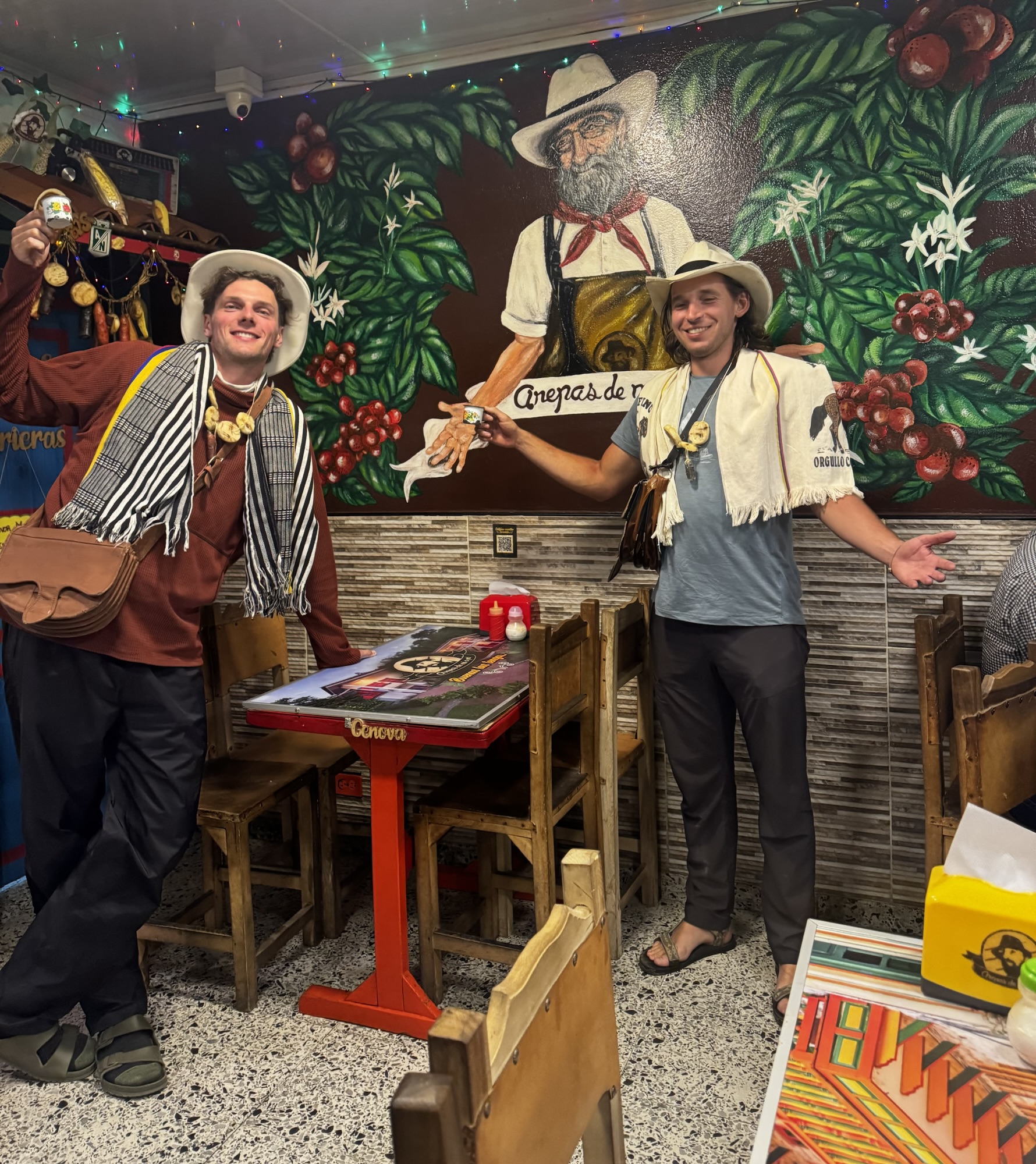
Dinner that night was funny. We were looking for a “cool local” spot and ended up at an arepas place (pic below). The moment we walked in, the owner shook our hands. Everyone was so over-the-top friendly that I couldn’t even pay before they made us put on traditional clothes and pose for a picture. It was great — a little forced, but also unforgettable.

Over dinner we started talking about what we actually wanted this trip to be. Do we go out of our way to find experiences like this? Or do we just let them happen? That night, we searched and it worked out. But soon enough we realized Colombia has its own rhythm. You can’t force these things — they either happen, or they don’t.
The beginning
The next day was our first real day. Let’s call the previous one Day Zero — we didn’t know it at the time, but looking back, that was just the warm-up.
Apparently, there was some kind of festival in town that morning, because the streets were absolutely packed. I swear I saw at least 2,000 people on bikes, all riding through a proper metropolitan city — not out in some remote valley. I couldn’t believe it.
From Bogotá, we dropped from around 2,700 meters of elevation all the way down to 300. A massive descent, but not without effort. During the day we still had to climb about 700 meters, and that’s when reality hit me. I checked my watch — my heart rate was sitting at 170–180 bpm. I couldn’t believe it. I thought I was fit.
At the same time, I wasn’t coming into this unprepared. Back in Lithuania, I’d done 3-, 4-, even 6-hour rides before leaving. But somehow, riding here for just 3–3.5 hours felt way harder. Sure, there was more elevation gain, the heat, a much heavier bike, and completely different riding patterns. Still, it was strange — I thought I’d built enough of a base, but the reality hit harder than I expected.
Suárez and Francisco
One day deserves its own story. We were planning to ride into a small town called Suárez. We chose that route so we could get off the main road, ride some gravel, and see more of the countryside. It was hot. It was hard. Honestly, I don’t remember many details about the ride itself—it didn’t seem like a huge day mileage-wise—but I just remember being tired and drained.
About 5 kilometers before town, Phil ran into a local named Francisco. Apparently, Francisco told him there was a festival happening in Suárez that weekend. Meanwhile, I had gotten a little ahead and was already in town, waiting for Phil to catch up to align on our next moves.
Suárez has a population of 1,000 people, yet there are multiple hotels—and every single one of them was booked three months in advance for the festival.
Francisco wasn’t just some random guy, though. After we helped him pump up both of his old bike’s tires (he’d ridden 15 km one way just to come to the festival), he basically adopted us. He made sure we had a place to sleep—on the terrace of one of the hotels. No room inside, but at least a roof over our heads. Lovely 25 degree heat at night still.

Later, we found out what the festival was all about: a bull-riding show. And, according to Francisco, he was one of the best riders in town. We thought he was joking but then he actually proved us wrong in the arena. You can see it in the video below

After the show, Francisco found us again in town and we sat down for dinner together. He seems to have a lot going on in his life, but at the same time he’s living it to the fullest. At one point, he told me I shouldn’t go by my name, Rokas, in South America — it’s too complicated. Instead, he suggested I go by Diego. I’m not sure about it yet. I’ll see if it grows on me.
The actual riding
Let’s be real — you don’t care about the everyday details of riding, so I’ll just put it all together. Riding here is different. Very different. Even when we go for what Phil calls ‘the path of least resistance,’ something always comes up. Sometimes it’s brutal climbs, sometimes it’s the heat. On one day we thought we had flat terrain, but it was so hot I ended up drinking 5 liters of water, 1 liter of freshly squeezed juice, 1 liter of Coke, and 1 liter of Gatorade. I think that’s a lot. I peed once.
Back home I cycled close to 2,000 kilometers before this trip and thought I was ready. I wasn’t. I kept praying for my ‘bike legs,’ if such a thing even exists, to finally kick in. Instead, the thought of not being ready kept creeping in and making me feel weak. And the worst part? These were supposed to be the flat days. Sure, the heat was insane, but in my head I kept thinking: if this already feels hard, what’s going to happen once we start climbing for real?
And then the climbing came. In the next three days we had 250 kilometers and 5,000 meters of elevation gain. First day was brutal — inclines of up to 14.9%. For the first time ever, I had to push my bike uphill. I felt weak, but also free. Free because I realized I didn’t need to prove anything to myself anymore. If I need to hike-a-bike, I’ll do it. No shame in that. Still, 14.9%? What the hell is that?
But those days also showed me something important: I’m going to be in my lowest gear way more often than I ever imagined. The only way through is to treat it like constant Zone 2 training. So on mornings where we’d start with a 700-meter climb, I just accepted it. I put on some music, maybe sang a little, and just ground uphill with a 30 kg bike for over an hour… and all of this before breakfast.
By day 6 and 7 something clicked. We started climbing 1,500–1,600 meters per day while still doing 70–80 kilometers, and it actually felt good. My back didn’t hurt, my legs felt fine, and I could sit in my lowest gear for over an hour and just destroy a climb. That gave me so much belief in myself — that maybe this trip can only get better.
The bike’s holding up too, even through rough gravel that leaves my arms shaking. But that just makes the paved roads feel like heaven. I’ve noticed I enjoy the days with more variation — a mix of gravel, climbs, descents — because I can break them up in my head. We’ve also fully embraced jugos naturales. At least one a day, sometimes two, ok, sometimes three. And we’ve officially decided: jugo de mango en leche slaps.
I catch myself eating a ton, thinking about how to tweak my gear setup, and actually looking forward to a rest day. But overall, I feel happy. Things are coming together the way they should. The plan was never rigid, so having a good attitude and accepting that challenges will inevitably come has been key.
From the road, it’s not always breathtaking views — it’s more subtle. Riding through the countryside, seeing the mountains in the distance or slowly climbing one, feels just as good. Sure, I’ve almost been bitten by a couple of dogs, but I’m getting pretty good at the imaginary rock throw. Maybe that’s just going to be part of the toolkit going forward.
I’m also enjoying how much my Spanish is improving, just chatting with locals. People honk, wave, shout encouragements, or stop for a quick word. Being friendly back seems to go a long way. And little by little, I’m starting to feel like we belong out here.
Random picturs below:


The real learnings
This part is about the real learnings of week one. Everything I wrote before — the climbs, the heat, the dogs — those are just the superficial stories. They’re fun to read, and they give an impression of what the trip is about, but they don’t capture the real trial that the first week turned out to be.
Phil has a saying: “Everything that can break, will break on a trip like this.” And to some extent, I believe him now. Week one was a crash course in that.
Did things break? Oh yes. Let me walk you through it.
On day 3, one of the hooks on my Ortlieb front gravel bag snapped off. On day 4, I lost a screw on my second pair of Ortlieb bags attached to the rear rack. And then, the worst one: the parts I had put on myself — the front wheel and pedals — turned out to be the weak link. I hadn’t tightened the pedals enough, which ended up destroying the crank threads. That meant I had to replace the entire crankset.
The problem? My crank wasn’t common in South America. Replacing it would’ve meant ordering the part and waiting at least a week. There was no way I was going to stop for that long in week one. So I just decided to adapt: I went with a local crank, swapped things out, and kept rolling.
It’s funny — or maybe not so funny — how much my own incompetence cost me. The front wheel? I hadn’t put it on correctly. And that’s supposed to be the easiest job ever. Instead, it was wobbly, squeaking, and driving me crazy. Then there were the pedals. I hadn’t tightened them enough, and that little mistake destroyed the crank threads. The result? I had to replace the entire crankset and put in new pedals.
All in all, I basically paid $80 for my own incompetence. The only silver lining is that I’ve now got a sick new pair of pedals. Still, that’s how I learned — the hard way.

Oh yeah, and by the way — I also managed to over-pump my tires. Combine that with a brutally hot day, and they expanded until both my front and rear blew out. Luckily, they were tubeless, so they sealed themselves up, but not before splashing sealant over my face. A good reminder that even when the gear “works,” it still finds a way to humble you.
All this made me question myself: am I really ready for this trip? Doubt started creeping back in. But then I asked myself — how could I possibly be “ready” for something I’ve never done before? Naturally, the first week is a trial period. Things will break. And what’s most frustrating is knowing that back home, these problems could be fixed in a day and for a reasonable price, while here in South America some fixes are nearly impossible or painfully slow. That’s just the reality I have to accept.
Looking back, I know I could have done a better job preparing my setup. I didn’t really test my gear, I didn’t run proper checks. I just thought: I’ll figure it out on the road. And now I’m paying the price. I’m not fully committed to the setup I have, and I keep thinking about what I could change or improve. But maybe that’s not such a bad thing. I can’t change everything right now — and if I can, I will — but I can’t hold myself hostage to what-ifs either. It’s easy to look back now and say, this would have been the perfect setup for Colombia. But truthfully, when I rolled out on day one, I didn’t even know what roads we’d face, what terrain we’d cross, or what surprises would hit us along the way.
Random thoughts
1) The first thing that really hit me: Colombia is way more urban than we expected. We thought this would be a camping-heavy trip, but the reality is different. It’s hot — brutally hot — and by the end of each day we usually just want a bed, a shower, and a fan. So instead of pitching tents, we’ve been “credit card camping,” or maybe better said, “ATM camping.” Most nights we end up in small-town hotels, $15–20 total for the two of us — so basically eight or ten bucks per person. It’s simple, cheap, and it works.
And to be honest, when we’re at lower elevations, there’s no way I’m sleeping outside. It’s 25 degrees, humid, and full of flies. After pushing my body so hard all day, the last thing I want is a sleepless night. Proper rest feels just as important, so if that means a cheap hotel bed instead of a tent, I’ll take it. We are slowly starting to sleep outside when the conditions feel right, but for now (in Colombia) this trip is definitely not the full-on camping adventure we imagined.
2) Before the trip, because as I mentioned I haven’t tested out the gear, I bought just basic, random cycling gloves from Decathlon that are double extra large size, and they’re too small for me. What does that say about my hand size or what does it say about Decathlon sizing?
3) Absolutely no one knows Lithuania
4) We’re still trying to figure out — is it actually that hot, or is it just us who can’t handle the heat? But you know what, when even the locals are sweating and complaining, you know it’s hot. That’s why I’m extremely excited that next week we’ll start climbing above 2,000 meters of elevation.
5) I’m trying to eat a lot, to consume as many calories as possible — maybe even too many. I’m not sure I’m burning as much as I’m taking in, or at least not the amount I’d like to think I am. But in the last couple of days, I’ve noticed something new: I’ve actually started feeling my ass bones pressing into the saddle. I don’t know what that means or if I need to change something, but it definitely feels weird.
6) I’m sorry, I gotta say it — I don’t like Colombian food. It just feels like it lacks taste. We even started using “Colombian food” as a metaphor for anything bland. Sure, we’ve found a few hidden gems here and there, but honestly, the bar is low. I haven’t been to a country that screws up French fries so badly — like, how is this even possible? I’m shocked. Why the hate for salt? Why does everything have to be deep-fried? And vegetables… what happened to vegetables?
That said, I have to admit — pan de abuela slaps. I can easily have 3–4 pieces for breakfast and still have room for more. So I guess the positives kinda cover the negatives.
And yeah, don’t trust Google Maps — the places open when they feel like opening, and they close when they feel like closing.
That said, I have to give credit where it’s due: the jugos naturales are amazing. Mango, piña — those I could drink every day. But then there are the other fruits, the ones we don’t even know in Spanish: lulo, guanábana, mora. I’m sorry, but they’re just bad. The way I see it, the reason we hadn’t heard of them before is simple — they don’t get exported because they just aren’t tasty enough.
7) I kept the last point for those who stayed with me until the end. This isn’t mine — it came from an old Navajo man Phil met once in Albuquerque, New Mexico. He told Phil, “You’re chasing what you’re running from.” Phil told it to me, and now I’m passing it on to you.
Pués
Pues, ahora llega la parte que no puedo expresar tan bien como en inglés: ¿qué tal va mi español? La verdad, no lo sé con certeza.
Durante la semana, Phil y yo vimos un par de películas y entendí como el 70–80% de cada una. Al mismo tiempo, escuchando a la gente, también estoy aprendiendo mucho.
Puedo entender lo que la gente dice por aquí, pero quiero hablar más y mejorar mi español. Necesito estudiar un poco más la gramática, escuchar más y practicar más. Ayer leí mi primer libro en español: un librito pequeñito que me tomó unos 30 minutos.
La cuestión es: ¿cómo puedo saber si estoy mejorando? Escucho español todos los días y hablo con la gente, pero siento que las frases que uso son casi siempre las mismas. ¿Qué más debo hacer para avanzar?
Estuve muy feliz cuando fui a arreglar mi bici: más o menos entendí lo que el mecánico me decía sobre lo que había que hacer. No pude responder mucho, pero entendí la mayor parte, y eso me dio confianza. Creo que mi español seguirá creciendo en los próximos meses, al mismo ritmo que mi aventura en bicicleta.
Stats
First Week Cycling in South America
523 km | 26h 49m | 6,552 m gain | 13,714 kcal
Daily Averages
74.7 km | 3h 50m | 936 m | 1,959 kcal
