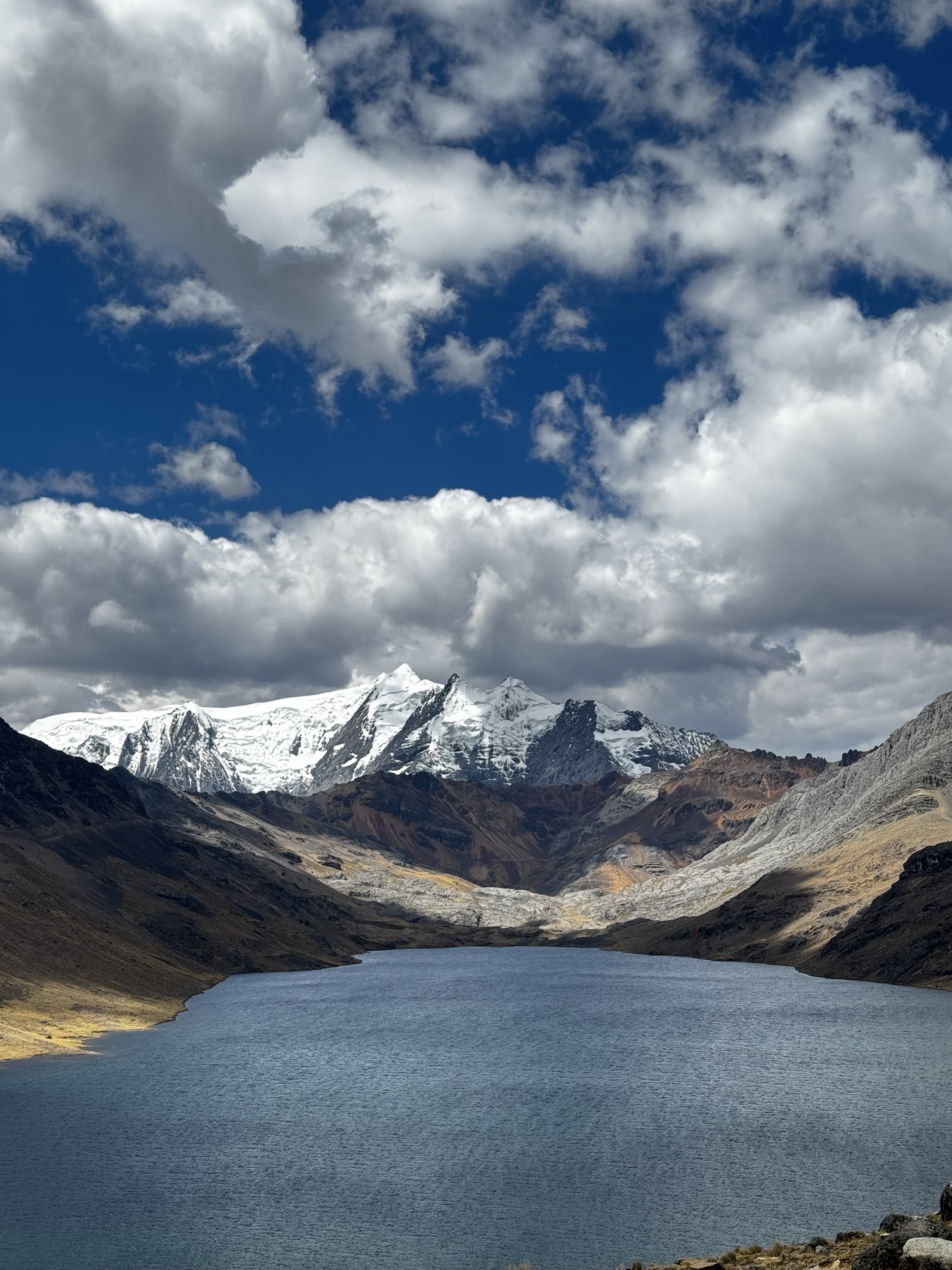
Peru Great Divide (PGD)
Continuing on the PGD, the next day we finally had our first beautiful one. And by beautiful, I mean we actually managed to climb the whole thing without pushing the bikes. It wasn’t too bad — about 700 meters of climbing — but the pass topped out at 4,800 meters. It felt amazing to actually ride it all the way instead of pushing the bike uphill.
The day after, we decided to rest in the town of Chicla. Calling it a “town” might be an overstatement. Google Maps showed four restaurants, but in reality there was just one: Juanita’s place. Lunch, snacks, next day’s breakfast, and even a takeaway lunch all came from there. Food options were basically the same every time — menu del día (chicken, rice, maybe some veggies if you’re lucky) and a questionable soup.
We decided to skip the next 20 kilometers. It was too steep, and with our non-mountain bikes we would’ve just ended up pushing for 2–3 hours. So we hitched a ride with a local driver and wound up in the small mining town of Yuracmayo, sitting at 4,200 meters.


The interesting thing about my sleeping rhythm is that I still haven’t figured it out on this sleeping pad. On the PCT and CDT it usually took me about two months to settle in, and it feels the same now. I start on my back, then roll 90 degrees to my right side, then stomach, then left side, then back again. And I just keep repeating that cycle dozens of times every night.
What followed after was pretty brutal. We camped at 4,200m, then climbed up to 4,900m. From there it was a descent to 4,100m, then straight back up to 4,700m, and finally back down again to 4,200m. Honestly, that day was no fun, with 2–3 hours of bike pushing. I felt like I was either grinding away in the lowest gear, pushing my bike, or just sitting still on the downhills without pedaling at all.


And the day felt really tough. I kept telling myself that our goal was to reach Huancavelica, kind of a town that sits about two-thirds into the PGD. I thought, I survived today. Yes, I had to push the bike, but tomorrow should be a little easier—only 800m of climbing in total.
But honestly, just staying above 4,000m for days in a row really hit us. It especially hit Felipe—he was feeling sick, barely eating more than soup, low on energy, moving slow. At that point, we remembered the “constitution” of our trip: it’s not about taking the hardest route. And the PGD might be one of the hardest routes out there. For us, it’s about enjoying the journey, having fun, focusing on the joy. If there’s an easier path or a different way forward, we should take it.
And to be fair, gravel bikes in the Andes really don’t make sense. These mountains demand proper mountain bikes. Our lowest gear just isn’t anywhere close to what this terrain requires.

Post PGD
So we decided to drop lower toward the coast and either pick another route or just skip ahead. And yes, going down from the mountains felt easier in theory—but in reality, not so much. Sure, the average speed jumped over 20 km/h (which has only happened two or three times on this whole trip), and we even managed to cover 100 km in a day. But the 30-40 km/h wind was always blowing straight in our faces.
That’s just one of those funny things in life: no matter which day you choose to ride, there’s always something. You never get the perfect day. The only real choice is whether you complain about it, or focus on the little things around you that make the day manageable—and maybe even enjoyable.
The coast
Coming down from the quiet madness of the mountains, the Peruvian coast hit hard. Honestly, it sucks. It’s just endless sand, poverty everywhere, and constant honking and noise. After the tranquility up high, it all felt overwhelming.


Tuk tuk taxi Peru
There were so many taxis that we actually started asking ourselves—why are there so many? Is this really a reasonable way to make a living? Sure, they can earn something, but it can’t be much. At the end of the day, do you really want to sit in your car all day, honking, waiting for people, and picking them up along the way?
But then, playing devil’s advocate, we thought—alright, in the Western world most of us sit in an office 11 months a year just to take 4–6 weeks of holiday. Here, these guys are basically chilling all year. They don’t need to “escape” for vacation, because their whole rhythm is slower. Yeah, they honk, but maybe that’s part of their fun. They drive around, pick people up, talk, move from place to place. They make less, but maybe they’re not stressed in the same way.
So it got us thinking—maybe that’s why they’re so chill. Or maybe not. I guess we’ll never really know.
Ica and tourists (and us)
So, we finally reached Ica, and we decided to do what all the other tourists do—see what’s happening. The main attraction? The desert of Huacachina. Well, “desert” is maybe pushing it a bit—it’s really just this little oasis surrounded by massive sand dunes. And yeah, it looks amazing.
When we got there, it was tiny and packed with people. Tourists from everywhere, people selling dune buggy rides, sandboarding, skiing down the dunes… basically all the usual tourist chaos. We just started talking and were like, yeah, this is fun, this is what people do. But then, you know, Felipe and I just don’t get the whole “travel by hopping from one tourist spot to another” thing. We don’t really travel like that—we don’t just stay with other travelers and go through the official “must-see” route.
And, yeah, I’ve done a lot of backpacking before, so I get it—sometimes this is just how it works. You have to hit the popular spots to get by. But if we told people we’re just cycling around the desert, most of them wouldn’t even understand. There’s this huge gap between what we like and what other people like.
At the end of the day, though, I guess there’s no right or wrong way. Everyone picks their own way to travel, and that’s fine.


Qué más
Pues, desde Ica no había muchas opciones de ruta. Solo hay una carretera por la costa que todos los autobuses toman, ya sea hacia Lima o desde Lima. También podríamos haber regresado a las montañas, pero como nosotros no podíamos volver por la ruta difícil, decidimos tomar un autobús hasta Arequipa, donde vive la madrina de mi amigo Felipe.
Pues, por este lado me parece que este viaje es de los más difíciles que he hecho, y lo digo por una razón: no puedes planear mucho para las semanas que vienen. Todo cambia más o menos cada día, cada tres días. Solo puedes ver lo que va a pasar en los últimos días o quizás en la próxima semana.
Estábamos pensando en recorrer todo el Perú por la Great Divide, pero solo hicimos como medio día y ahora cambiamos de plan. No pudimos estar demasiado concentrados en el plan que teníamos al principio, solo puedes enfocarte en el presente y, como mucho, pensar un poco dónde te gustaría estar en unos días o tal vez en algunas semanas, pero no más que eso.
Pues, lo bueno de todo esto es que te estás enfocando más en el presente, no en el futuro, y quizá eso es algo que me gustaría aprender más en mi vida. Ahora estamos descansando en Arequipa y después seguimos adelante.
Weekly Stats (5 days of cycling)
395 km | 20 h 59 m | 3,567 m gain
Daily Averages
79 km | 4 h 12 m | 713 m gain
